Robin’s Flight From Earth

He was part of our identity—all of Marin really, but mostly those of us that went to school with him. I went to school with him but we weren’t friends or buddies. He was friends with my friends and I knew who he was because I knew who everyone was; he might have known who I was—we never talked about it later. And later he worked with my boyfriend in Sausalito, and after that I became a good friend of his brother Todd. We knew each other. He was Toads little brother and I was Cable Car Katie, a name Todd gave me since that was my usual mode of transportation. We didn’t hang out unless we were both visiting Todd at his bar on Chestnut Street in the Marina. And then, we were quiet, polite, and probably thirsty.  I waited on him when I was a waitress in Sausalito. I left him alone- and he appreciated it. He was an introvert when he wasn’t being an extrovert.

I was in a management class about 20 years ago in Livermore, California. I might as well have been a 1000 miles away from Marin it was so different there. The terrain, the people, the smell… nothing was the same. The man who was facilitating the class asked all of us to write down something that most people didn’t know about us.  I never write anything of consequence when asked to do this because if people don’t know things about you they probably shouldn’t—so I wrote down I WENT TO SCHOOL WITH ROBIN WILLIAMS.

When we read them aloud, the facilitator’s head snapped to me… and he said, “That’s what I wrote too.”

He had gone to College of Marin with Robin; I had gone to Redwood High with him.
 

Marin County has had many stars, a lot of favorite sons and daughters. Some spent only a short time here and we claim them anyway… like greedy little grubbers who want all the credit for other people’s success.  Writers, musicians and actors often find Marin County amenable to their needs. We don’t chase after them or ask for autographs, sometimes we nod, but mostly we let them alone and maybe that is the attraction.

Robin always had a melancholy layer just below the surface. If you ever met him, you would know that. And like many people that suffer from depression, reason escaped him, logical thought was stuck in some deep dark pocket of his brain and what surfaced was the last resort, the last decision he would ever have to make.

He was part of our identity—in some weird subconscious way. So the fallout of his demise – his purposeful leap to the next world, has been hard. It’s taken a toll on so many people – some that never met him but loved him for his art. And those of us that knew him, though not well, we are left with an empty feeling, and ask, “How could you leave this soon?”

He’ll be part of the Redwood High Memorial Wall now, a wall I was just reading all the names on last week. I was thinking I should add my little brother and now there is one more, and College of Marin’s Memorial Wall too. Maybe they’ll have a plaque at some bar he went to once or twice, and the along the Dipsea Trail. He won’t be forgotten anytime soon– but what killed him will be, it always is.

I wish, I know we all do, that he would have picked up a phone.


The Good Old Days


<!–[if !mso]>st1\:*{behavior:url(#ieooui) } <![endif]–>

A lot of people send out emails talking about the good old days…mostly about the 50s and 60s. After several years of reading these selective memory, partially fictionalized notes– here is my response.
I grew up in the 50s and 60s, and I can tell you without a doubt – they were not great. Many women were slaves to their kids and husbands, many of them were physically and mentally abused with zero recourse because divorce was frowned upon and the law didn’t care. Parents could beat their kids bloody without consequence. (Save for the doctor bills and psychiatric care later.)  War veterans suffered in silence because it wasn’t manly to wake up screaming from nightmares or the have the shakes every time they were in a crowd. Black people still couldn’t vote or go to the same schools as whites, and were hung for sport, and just forget about being gay—you would have to go live in Europe if you were out of the closet gay. Our president was assassinated, we lived in constant fear of war, the McCarthy Erawas born and stomped all over the rights of many Americans who dared to have an opinion about anything.  The Cold War, the Korean Conflict, Vietnam War ; inequality on myriad levels, all served to make the 50s and 60s a blight on America’s history.  Leave it to Beaver” was a ridiculous delusion.
Mom, me, Bama, baby Johnny & Linda 1955 Alemany Blvd. San Francisco
I have some warm memories. I remembering visiting my Great Grandmother, my BaMa, in Santa Rosa on Sundays, feeding the chickens and looking for their eggs, and her teaching me to sew on her Singer sewing machine, and bake the best German butter cookies in the world. Watching the birds in the aviary while sitting in the sun-drenched kitchen, the German canaries singing their glorious songs, and the homemade jams spread on the homemade breads. Papa Carl playing solitaire for hours on end and not saying much of anything but letting me sit on his lap and help. We’d sit outside in the shade under the grape vines that grew over a trellis, and sometimes pick berries to make jam.
In the fall, we would gather walnuts from the giant walnut tree and spend what felt like hours, cracking the shells, then baking chocolate chip cookies and warming her house and filling it up with the smell of fresh cookies coming from the old Wedgwood oven.
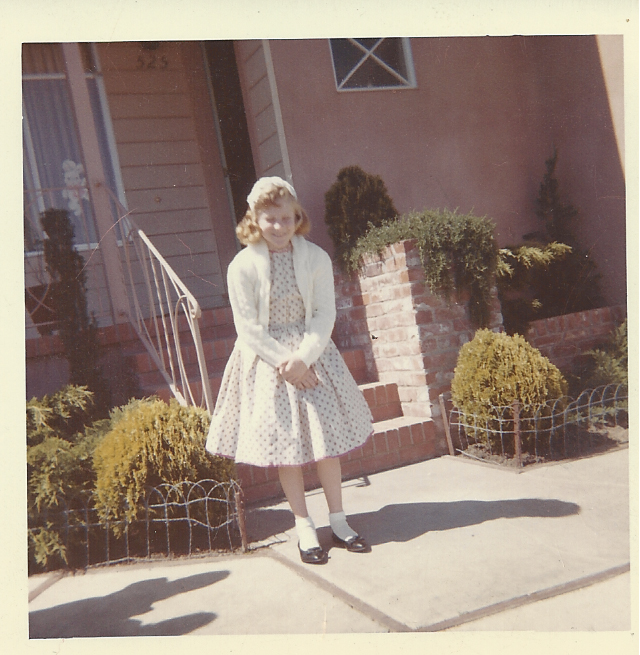
Easter 1960ish  in San Bruno @ Uncle Pete Scanlon’s house
I was lucky to have those memories. My innocence was lost long before my innocence was lost. My parents, until their divorce when I was four, had knockout, drag down fights that left my older sister and I trying to be invisible, curled up in our beds, often huddled together – a temporary peace treaty between water and oil. Still, she remembers the 50s with more kindness than me. I have a steel-trap memory—with amazing clarity, sometimes it’s a curse, but for the most part I’m glad I remember what’s real.
Kids were kidnapped, molested and murdered—just like today. The difference between then and now is there are more people now, and we now receive news from every city in the nation.  In 1960 you read your local paper, which had local news, unless it was about the President or a war. In the early 1950s 25,000 cases of polio were reported a year, killing many people and crippling even more. If you had cancer, leukemia or heart disease—you probably died. In the 1950’s-60s, if one was born premature, they probably died or were severely brain damaged and the doctors would tell the devastated parents to put the child in state or private care. If you had any kind of mental illness, you would have been institutionalized and/ or forcibly treated with electro-shock therapy or worse, a lobotomy, which would render you semi-comatose for life. Menopause was treated as mental illness.  Teenagers (some I went to school with) were forced to give up their babies or marry if they got pregnant out of wedlock. (Often ruining lives.)
Add caption

We have our problems now; there is no doubt. We have been at war for well over 10 years. We have a multitude of veterans suffering from PTSD and TBI. We have gang violence, too many guns on the streets, homelessness, untreated mental illness and the economy, while improving is not quite there and many people are jobless and living far below the poverty level. We have many diseases yet to be cured; global poverty, the War on Terror. Yes, we have our problems.
But, I will take now over then anytime. We have vaccinations if not cures, for polio, chicken pox, measles, mumps, pertussis and more. We have prosthetic devices that look and feel like part of your own body. We have heart, lung, kidney and liver transplants. We have face transplants. We have medication for schizophrenia. Breast cancer is not a death warrant. People are living longer and healthier than they ever have before. Life expectancy is 10+ years more than in was in 1950.
The 50s and 60s may have had some bright spots but none that out weigh the repulsive bigotry, the disgusting lack of respect for the Constitution of the United States and the people’s right to privacy and the overall head in the sand denial of the nation.
As I age, I hope to remember the unabridged past and not the one made up for email forwards, Facebook posts and chain letters. If there was innocence in the 50s and 60s it was self induced. I don’t think we should make that mistake again. I would rather face a hard truth than live an easy lie. The truth is… drinking water from a garden hose is not a good idea.

Eugene’s F Bomb

<!–[if !mso]>st1\:*{behavior:url(#ieooui) } <![endif]–>
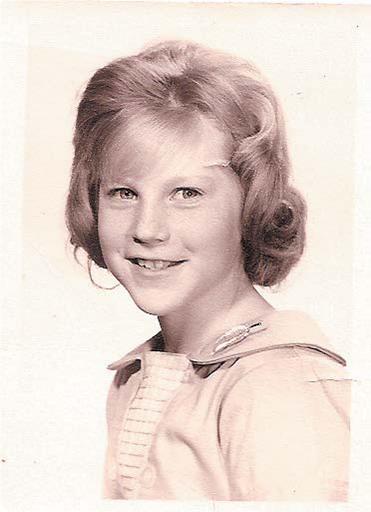
5th Grade Longfellow Elementary San Francisco
In my fifth grade class at Longfellow Elementary in San Francisco, a boy named Eugene sat behind me. I can’t remember Eugene’s last name but it was something like Smith or Brown.  Eugene had reddish-brown hair and brown eyes, some freckles and an unremarkable look about him. His unique distinction- and we  all have one- was that he would let the F-bomb fly about twenty times a day. In 1962, in 5th grade, that was unusual.
I was a Safety Patrol. I took my safety patrol job seriously. I would wear my white belt and hold back the pedestrians until it was safe to cross the street. I obeyed the rules and I enjoyed enforcing them. I remember taking care of that white belt as if it were a living thing. I was proud of my job.
Eugene annoyed me. In addition to his cussing, he picked his nose. Since I came from a family that smacked you if you picked your nose I made an effort to never look at him because I knew I would hit him.
As the school year neared the half-way mark, I found myself hating Eugene. He started to look rat-like to me. I’m pretty sure he hated me too. Mrs. Renstrom, I have no doubt, was sick of me telling on him as much as she was sick of him swearing and finally moved me to a different spot. How she handled him, I don’t remember.
Now though- some 50 years later I think I was a little too harsh on Eugene. The F-bomb is my favorite word. I use it when I am happy, mad and sometimes sad.  It’s descriptive, it’s definitive, and it makes me feel better. It’s a little mini stress reducer in an extremely stressful world. It’s just a little word- yet it carries enormous impact. I get it now- I really do.
I would like to officially, apologize to you Eugene.  You may have grown up to be a nose picking creep, or maybe you are in the FBI or CIA or a politician somewhere. Maybe you died in some war or from some drugs or maybe you are happily married now, with four kids and six grandkids, all running around dropping the F-bomb for you.  I just want you know I get it- and Mrs. Renstrom probably got it back then. She probably felt the same – being in charge of 30 plus 5th graders when the world was changing faster than she could learn about it- let alone teach us.
Now, I can say I see the need for rules, but I break many of them. I’m loathe to make others follow any rules, too many years of herding cats to want to do that anymore. Now- I just say fuck it- and move on.

A Banner Year

Nineteen-hundred and sixty- two was a banner year for me. I made it to the double-digit age, the magic 10, I was almost attacked by an aggressive German Shepherd, I helped catch a bad guy, I found my way home from four miles away in the San Francisco maze of streets, I learned a little about human anatomy, almost lost an eye and my dad helped solve a famous murder.

  
About three weeks into my fifth grade school year, my brother and I were playing or fighting and running down the hall in our new home in stocking feet on hardwood floors. I lost my footing and slid face first into the door jam between the rooms where I was trying to make my turn. By the time my mother picked me up off the floor, my eye had swollen shut and was protruding out and inch. She took me to Alemany Emergency where her mother had died from a car accident when my mom was eight years old. A drunk driver had run a stop sign on New Years Day. She didn’t want to be there, I remember her telling my step dad how she hated that place but she was scared I would lose my eye if she didn’t get me to the closest emergency room. I didn’t lose my eye, but I saw everything with a yellow haze for about a year (after I was finally able to open my eye at all) and my teacher at Longfellow paraded me around to all her teacher buddies like a circus act. It was quite grotesque. I had a lump on my eyebrow into my late twenties.
 
My brother Johnny, his friend Chuck, and I got lost in San Francisco when my dad dropped us off at Larsen Park one day. When he wasn’t there on time to pick us up I led the three of us on the four mile trek back to my moms house. I remember not really knowing where I was going, but pretending I did. We walked down streets I recognized but probably didn’t know their names. Past pastel stucco homes with carriage garage doors, and those great wide stair banisters I used to like to slide down. My brother Johnny, would have been about seven years old then. He never once complained about walking four miles on his crooked little legs. That kid was tough. I think that was the beginning of my bent towards leadership. Those two boys followed my lead, never once doubting I would get us home. Afterwards, I was damn proud of myself. A confidence building moment in time, which would both, help and hurt me throughout my life.
 
My dad was mad when he finally caught up with us. I guess he thought a ten year old would stand there and wait. I guess he didn’t know me very well.
 
My mom’s house was at the very top of a long street in San Francisco. From Geneva St. it was all up hill. Technically we were in Daly City, but a block away was San Francisco. My brother and I walked to school everyday, down Pope St. to Hanover then Lowell to Morse where Longfellow Elementary stood. Hanover St was always a little scary. There was a house on a corner lot that had three or four big German Shepherds tied up outside who would go crazy when we walked by. Growling and pulling at their ropes; as much as I loved dogs, I always sensed danger at that house.
 
One day one of them got loose and I wanted to run but Johnny stood perfectly still so I stayed with him. The dog charged us, growled and then wrapped his mouth around Johnny’s thigh, and still the only thing that kid moved was his big eyes when he looked at me for help. The dog never bit down. He scared the crap out of us though. We walked away very slowly, barely breathing. As soon as we were out of dog sight we ran like crazy all the way to school. We got in trouble for being late and when I told them what happened they didn’t believe me. My dad did though. I never saw the dogs outside again. I’m pretty sure some uniformed officer knocked on their door. I often wonder now, how Johnny knew not to move. Sometimes he just knew things.
 
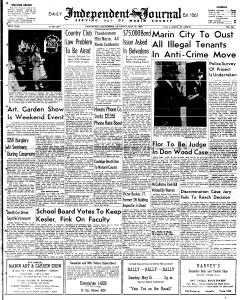
One of my favorite things of all time was when my dad picked me up in the paddy wagon. The paddy wagon was originally a detention van used to pick up and transport criminals, drunks mostly, converted to a Crime Scene Mobile Unit. But they didn’t use terms like that back then. It was just “the wagon”. He came to school in the wagon because he was working on a case about a half a block away. My dad was a San Francisco Homicide Investigator and the case he caught was a big one. I say he caught it, but I think every investigator in the department was on that case. The Iva and Ralph Kroeger case was front-page news. The house where they murdered Mr. and Mrs. Arneson was less than a block from my school. On this particular day when my dad came by school to pick me up, he had a big gash across his rather large nose. When I asked what happened he told me he was investigating a case and when he had gone to the basement a piece of wire was strung across the stairs and caught him in the nose. He wore the scar the rest of his life. That same basement was where they found the murdered couple.
While my dad worked his case- I worked a case of my own. Behind my moms house, high up on the hill butting up against San Bruno Mountain and the Geneva Drive in Theater, was a street called Bellevue. Because there were only homes on one side of the street and the theater on the other, we often played ball on that street. All of us kids, my brother, his buddy Chuck, and the Kellogg kids (there were tons of them) would play kick ball for hours. Sometimes we would hang out or build forts on the empty lots. One day one of the Kellogg kids noticed a man in the window and said he was naked. We all looked. I think I may have been the only one that didn’t really see anything. I saw him standing there, but I didn’t see what everyone else was seeing. Never-the-less, we all ran home to tell our parents.
 
The uniformed police came to our house to take a report.One of them told me he knew my dad. I remember them asking me if I could help them. Of course I could! They asked us to play out in front of the man’s house again. We didn’t have to look up they said. They would be there watching. The first few evenings nothing happened, but then- finally he appeared in all his glory. I remember running home, my face flushed from the foggy San Francisco evening and the excitement of helping the police. I hoped my dad would be proud, I wanted to be just like him.
Some weeks later, my cousins, actually they were my cousins, cousins, Trudy, Toot, Bubby and I were walking down Geneva St. to go to the Excelsior Theater. My stepdad was working at the Italian American Social Club on Russia St. at the time, about a block away from the theater. I can’t remember now, who was the first to notice the man walking behind us but it didn’t take us long to figure out he was exposing himself to us. We screamed and ran the block to Russia St. My step dad was busy working so he called my Nan to come get us. I don’t remember if he had any consoling words for us or if he even believed us. I do remember he gave us cokes and let us sit at the bar. I always liked doing that.
 
Nan was like our grandmother but in truth, she was my mother’s aunt. Nan had bleached blond hair, a whiskey voice, and an old San Francisco accent that many people mistook for New York. She smoked Viceroy cigarettes and talked “carny talk” with my mom. That was their secret language when they wanted to talk about things kids shouldn’t hear. They spoke so fast I thought it was Italian. She came by the house every night to tuck us in and tell us a bedtime story when my older sister and I were little. Now, since we were older she would just stop by and visit whenever she could.
When Nan picked us up, we told her what happened. She was not a bit surprised. “That was just a dickie shaker” she said. “It happens once in a while.” There was no horror, no lectures, no Catholic guilt. We weren’t scared for life by the little penis he held in his gnarled little hand. In fact, she had us joking about it by the time we got home. Nan was not afraid of much.
My Dad’s case went on for quite a while. His investigation took him to the two places he knew best in life- San Francisco and Santa Rosa. The murdered couple was from Santa Rosa the murderers from San Francisco. The search for Iva lasted a quite a while, then she was spotted in San Diego and brought back to San Francisco to be tried along with her husband, for murder.
 
That year, my dad taught me how to dust for fingerprints and transfer them to the special paper they had. He taught me about phrenology, no longer used today but I still keep that information in the back of my mind; and how to pay attention to people and my surroundings. He also taught me how to walk. Long strides he would tell me. If you are going to take long walks, use long strides and save your energy. I guess he knew me after all.