Robin’s Flight From Earth

He was part of our identity—all of Marin really, but mostly those of us that went to school with him. I went to school with him but we weren’t friends or buddies. He was friends with my friends and I knew who he was because I knew who everyone was; he might have known who I was—we never talked about it later. And later he worked with my boyfriend in Sausalito, and after that I became a good friend of his brother Todd. We knew each other. He was Toads little brother and I was Cable Car Katie, a name Todd gave me since that was my usual mode of transportation. We didn’t hang out unless we were both visiting Todd at his bar on Chestnut Street in the Marina. And then, we were quiet, polite, and probably thirsty.  I waited on him when I was a waitress in Sausalito. I left him alone- and he appreciated it. He was an introvert when he wasn’t being an extrovert.

I was in a management class about 20 years ago in Livermore, California. I might as well have been a 1000 miles away from Marin it was so different there. The terrain, the people, the smell… nothing was the same. The man who was facilitating the class asked all of us to write down something that most people didn’t know about us.  I never write anything of consequence when asked to do this because if people don’t know things about you they probably shouldn’t—so I wrote down I WENT TO SCHOOL WITH ROBIN WILLIAMS.

When we read them aloud, the facilitator’s head snapped to me… and he said, “That’s what I wrote too.”

He had gone to College of Marin with Robin; I had gone to Redwood High with him.
 

Marin County has had many stars, a lot of favorite sons and daughters. Some spent only a short time here and we claim them anyway… like greedy little grubbers who want all the credit for other people’s success.  Writers, musicians and actors often find Marin County amenable to their needs. We don’t chase after them or ask for autographs, sometimes we nod, but mostly we let them alone and maybe that is the attraction.

Robin always had a melancholy layer just below the surface. If you ever met him, you would know that. And like many people that suffer from depression, reason escaped him, logical thought was stuck in some deep dark pocket of his brain and what surfaced was the last resort, the last decision he would ever have to make.

He was part of our identity—in some weird subconscious way. So the fallout of his demise – his purposeful leap to the next world, has been hard. It’s taken a toll on so many people – some that never met him but loved him for his art. And those of us that knew him, though not well, we are left with an empty feeling, and ask, “How could you leave this soon?”

He’ll be part of the Redwood High Memorial Wall now, a wall I was just reading all the names on last week. I was thinking I should add my little brother and now there is one more, and College of Marin’s Memorial Wall too. Maybe they’ll have a plaque at some bar he went to once or twice, and the along the Dipsea Trail. He won’t be forgotten anytime soon– but what killed him will be, it always is.

I wish, I know we all do, that he would have picked up a phone.


A Hero You Won’t Hear About

st1\:*{behavior:url(#ieooui) }

Anyone can have PTSD, it’s not just a military issue. But combat veterans are suffering from PTSD at alarming numbers and there are simply not enough resources to help them- if indeed they are able to ask for help at all.
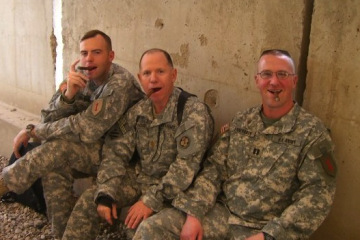
Dr.Linnerooth (on right) enjoying a cigar break.
Almost two weeks ago, the world lost another veteran to suicide. But he wasn’t just any veteran. He was a mental health professional who helped thousands of active duty and veterans make it to the next day. His first duty was to keep the troops from committing suicide.  Dr. Peter Linnerooth, a Bronze Star winning psychologist, a true hero, lost his battle with PTSD and took his own life five years after his active duty service to the Army.
The time he spent in Iraq was at the height of the war when the bloodiest battles took place and as an active duty member of the Army and a health professional, he would pitch in during mass causality events. It’s no wonder some of these events haunted him. Witnessing carnage of that magnitude would have an effect on the most grizzled warriors- let alone a lifesaver.
When Linnerooth returned to civilian life, he continued his work at Veterans Administration hospitals. First at the Santa Cruz County Vet Center in Capitola, then the Reno, Nevada Veterans Administration. He helped veterans suffering with mental health issues even while fighting his own demons.  
Dr. Linnerooth was extremely frustrated by the lack of  concern by the Army. A 2010 article titled Invisible Wounds: Mental Health and the Military, Time Magazine, quoted Dr. Linnerooth. “The Army has been criminally negligent,” says Captain Peter Linnerooth, an Army psychologist for nearly five years until 2008, who notes that the service has had a difficult time finding psychiatrists to care for combat vets, which puts even more pressure–“and way too much burnout”–on those who stay.

We owe our active duty troops and our veterans more than this. Through November of this year, 177 active-duty soldiers had committed suicide compared to 165 during all of 2011 and 156 in 2010. In all of 2012, 176 soldiers were killed in action, all while serving in Operation Enduring Freedom, according to DOD.
These numbers are not going to get better. If the war(s) end tomorrow we will still have 21.8 million veterans – many of whom are homeless, jobless and some in dire need of mental health care. Even veterans that are seemingly doing well may be struggling with PTSD and trying to hide it. The military mindset makes it extremely difficult if not impossible to express a need for help. 

I have heard people say (stupidly) that WW2 Veterans just pulled themselves up by their bootstraps and carried on… but I can assure you that is not quite the way it was. My own Great Uncle helped pick up the bodies and body parts of Marines on Iwo Jima and into his 90’s and until his death at 91, shook when any war was mentioned. They suffered in silence, but they suffered greatly- and still to this day have flashbacks and nightmares.  According to one study, “The suicide rate among these (WW2) veterans is roughly double the rate of veterans under 35, those who are returning home from Iraq and Afghanistan.” 
Since my own son returned from Iraq, in 2007, I have tried to raise the awareness of Combat PTSD. Like most things – unless it affects you personally PTSD is not something people are interested in. Many of the people with little or no interest in this matter will be out on the July 4th, in the parade, or on the sidelines, waving their flags, drinking their beers or pink lemonade and having a good time. So please remember when you are there, we are celebrating on the backs of these fine men and women who have sacrificed their lives, their limbs and in many cases their mental health for the sake of our country.
Try not to make assumptions about the homeless vet living under the bridge and drinking himself to death. A slow suicide is still a suicide and these men and women are everyone’s responsibility- we owe it to them to help- at the very least- we owe them some compassion and a huge thank you for their sacrifice.

If you are a veteran and thinking about suicide I beg you to check out this site and call the Suicide Hotline. You will be talking to people who understand your pain.

If you know someone that is suffering from combat related PTSD and would like to help them or understand what they are going through, I urge you to visit this website: Hearts Toward Home
Dr. Cantrell has helped thousands of active duty, veterans and their families work through their PTSD and related issues.  In my book, she is a hero too.